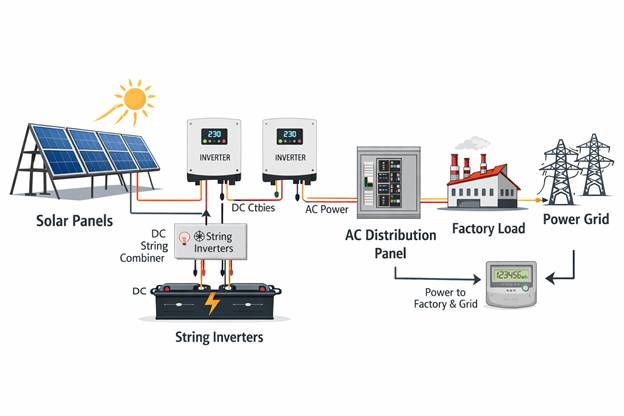
For a factory in Egypt, the recommendation becomes much more specific—and more strategic—because factories have high energy demand, large surfaces, and long operating hours.
Here’s the best real-world solution used in Egypt today (based on actual industrial projects):
✅ Best Installation Method for a Factory in Egypt
🏭 Hybrid Approach: Rooftop + Ground-Mounted (if space available)
1) Primary System: Roof-Mounted Tilted PV (Industrial Standard in Egypt)
👉 This is the most widely used solution in Egyptian factories
- Used in major projects like:
- Coca-Cola factory rooftop solar plant (~1 MW)
- Samsung factory rooftop system (~4.2 MWp)
Why it’s the best starting point:
- Uses existing factory roof (zero land cost)
- Proven in Egypt under net-metering regulations
- Reduces electricity cost significantly
- Can be installed under PPA model (no upfront cost)
🔧 How it should be designed (IMPORTANT for Egypt):
- Tilted structure (NOT flat) → improves cooling & output
- Tilt angle: 20–30° جنوب (south-facing)
- Leave spacing between rows for cleaning access (dust issue)
- Use industrial-grade mounting (wind + heat resistant)
⚠️ Limitation:
- Rooftop alone usually covers 20–40% of factory load only
👉 This is confirmed in practice—factory loads are usually too large for roof area alone.
🥇 2) Add Ground-Mounted System (if land is available)
This is what smart factories in Egypt are now doing.
Why:
- Factories consume large power → rooftop is not enough
- Ground systems allow scaling to MW level بسهولة
Example:
- Industrial + commercial PV projects in Egypt combine rooftop + ground systems
Best design:
- Fixed tilt system (low maintenance)
- Optional: single-axis tracking for large plants
⚙️ Recommended System Configuration for Your Factory
🔌 System Type: Grid-Tied (On-Grid)
with Optional Hybrid Backup
Why:
- Cheapest and fastest ROI
- Egyptian regulations support net metering
- Batteries only if:
- Power cuts affect production
- You need backup for critical machines
📊 Realistic Performance Expectation in Egypt
- High solar radiation = excellent production
- Example:
- 1 MW rooftop system can generate ~1.5–2 GWh/year in Egypt conditions
🔥 Critical Design Challenges in Egypt (Factory Level)
1. Heat
- Panel temperature can exceed 70°C → reduces efficiency
✅ Solution: elevated mounting for airflow
2. Dust & Sand (Major Issue)
- Reduces output significantly
- Requires regular cleaning (weekly or biweekly)
3. Mechanical Stress
- Wind + sand abrasion damages panels over time
✅ Use desert-rated panels (TOPCon / anti-soiling coating)
💡 Final Recommendation (Simple & Practical)
👉 If your factory has:
✔ Large roof only:
➡️ Go with:
Tilted rooftop PV (on-grid)
✔ Roof + empty land:
➡️ Go with:
Hybrid system = Rooftop + Ground-mounted (BEST OPTION)
✔ Very high energy consumption:
➡️ Consider:
- Rooftop + ground + possible PPA solar farm offsite
🎯 Bottom Line
For a factory in Egypt:
Start with rooftop solar (low cost, fast ROI), then expand with ground-mounted systems to cover more load
✅ Help & Support
If you want, tell me:
- Factory type (e.g., food, steel, textile)
- Monthly electricity bill
I can calculate:
👉 System size (kW / MW)
👉 Estimated cost in Egypt
👉 Payback period (very important for decision)