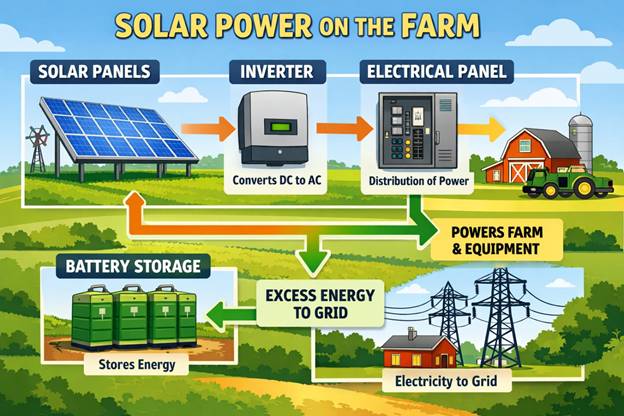
For a farm in Egypt, the situation is actually ideal for solar—because you usually have open land, high sun exposure, and often unreliable grid access. That changes the recommendation compared to factories.
✅ Best Installation Method for Farms in Egypt
🥇 Ground-Mounted Fixed-Tilt PV System (Top Recommendation)
Why it’s the best:
- Farms have plenty of land → no space limitation
- You can orient panels perfectly → maximum energy output
- Better cooling than rooftop → higher efficiency in Egypt’s heat
- Easy cleaning (critical due to dust and الرمال)
- Simple design → low maintenance and long life
⚙️ Optimal Design for Egypt Farms
🔧 Tilt & Orientation
- Tilt angle: 25°–30°
- Direction: Facing south (أفضل إنتاج)
🌞 System Type (Very Important)
1) 🚜 Off-Grid System (Most Common for Farms)
Use this if:
- No reliable electricity grid
- Remote desert or agricultural land
Components:
- PV panels
- Inverter
- Battery bank (or water storage alternative)
Best use case:
- Irrigation pumps
- Lighting
- Farm equipment
2) 🔌 Hybrid System (Best Practical Option)
Recommended for most farms today
- Solar + grid + optional batteries
- Uses solar during the day
- Grid or batteries as backup
👉 This gives:
- Reliability
- Lower electricity bills
- Flexibility
3) ⚡ Solar Water Pumping System (Highly Recommended)
This is one of the most successful applications in Egypt agriculture.
How it works:
- Solar panels directly power water pumps
- Water stored in tanks instead of batteries
Advantages:
- No battery cost (huge saving 💰)
- Very reliable
- Perfect for irrigation
🥈 Optional Upgrade
Single-Axis Tracking System
Pros:
- +15–20% more energy
Cons:
- More maintenance (dust + الرمال)
- Higher cost
👉 Recommended only for:
- Large commercial farms with technical support
🚫 Not Recommended for Farms
- Rooftop systems → usually small and inefficient
- BIPV → unnecessary and costly
- Complex tracking (unless large-scale project)
🌵 Key Challenges in Egypt (Farm Environment)
1. Dust & Sand
- Biggest issue in farms
✅ Solution: - Clean panels every 1–2 weeks
- Use anti-soiling coated panels
2. Heat
- High temperatures reduce efficiency
✅ Solution: - Ground-mounted with good airflow
3. Water Availability
- Ironically needed for cleaning
✅ Smart solution: - Use drip cleaning or scheduled cleaning with irrigation system
📊 Typical System Examples (Egypt Farms)
🚜 Small Farm
- 10–30 kW system
- Runs irrigation + lighting
🌾 Medium Farm
- 50–200 kW
- Multiple pumps + storage
🌴 Large Farm
- 500 kW – 2 MW
- Fully solar-powered operations
💡 Final Recommendation
For a farm in Egypt:
✅ Go with ground-mounted fixed-tilt system + solar water pumping (if irrigation is needed)
🔋 Add batteries ONLY if you need power at night
⚡ Use hybrid system if grid is available but unstable
🎯 Simple Decision Guide
| Situation | Best Choice |
| No grid | Off-grid solar |
| Irrigation focus | Solar pumping (no batteries) |
| Grid available | Hybrid system |
| Large farm | Ground-mounted + optional tracking |
✅ Help & Support
If you tell me:
- Farm size (acre or feddan)
- Number of pumps or HP of motors
I can design for you:
👉 Exact system size (kW)
👉 Number of panels
👉 Estimated cost in Egypt
👉 Payback period (important for investment)